
The Hidden Challenges of Direct Container Furniture Imports
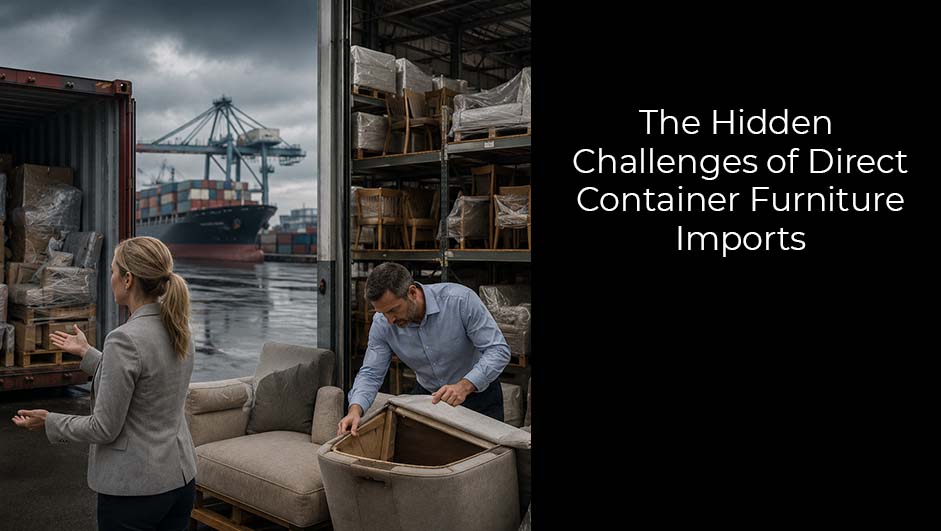
It would be a dream come true for many Australian furniture retail store owners who want to cut down the cost of good purchases by bypassing the local agent and ordering products in bulk via a shipping container. However, the international cargo market is one of the most complicated industries with a huge amount of risks and uncertainties.
What may seem as a simple and logical move at first look can easily become a real logistical nightmare. You need to be prepared for unexpected expenses, delayed deliveries, and significant financial losses which will damage both your business and local reputation.
Before you transfer money abroad to purchase your product stock, it is crucial to fully hold the concept of international logistics. (If you are interested in the detailed description of the process, you can refer to our article on How to Order Furniture by Container in Australia: A Complete Guide.)
We will examine the hidden problem that arises when importing containers of furniture directly in this article. Once we have identified all the significant risk, we will reveal how to navigate around each of these barriers effortlessly, allowing you to make a lot of money.
1. The Trap of Massive Minimum Order Quantities (MOQs)
However, when making purchases from foreign manufacturers, one cannot purchase just five dining tables or several sofas to see how customers react to the style of furniture. In overseas companies, production is based on large economies of scale. This means that they make clients order very substantial Minimum Order Quantities (MOQs).
In other words, in order to work with such a supplier, a person should order at least 50 to 100 items, all the same and all in one color to switch on its machines. Additionally, one needs to order large volumes to fill the 20-foot or even 40-foot container completely. It is a major financial trap for individual entrepreneurs.
Ordering a full container means tying up tens of thousands of dollars. When one orders the wrong things and discovers that the specific green velvet sofa, for instance, does not sell in the local market, he or she loses access to that cash forever. One will be dealing with a mountain of useless stock occupying the warehouse area.
Without cash flow, there is no way to pay for advertisement, hiring additional employees, and ordering other goods for the store's presentation purposes.
2. Uncertain Delays and Wild Ocean Shipping Cost
Your calculation of expected gains from direct shipments is made based on the current cost of ocean transportation. Yet, the cost to send a container to your customers will keep changing in response to demand and fuel prices. The price you pay for sending one now may be twice as much once your factory finishes assembling your product.
Apart from cost, international shipping delivery times are not reliable. A typical route takes a month or two at sea, but there is also the lead time from your manufacturer and additional delays when unloading the product at the port of arrival. In general, the delivery will take three to four months.
However, the process can be easily affected by problems. A sudden strike, harsh weather conditions, global shortages of containers, and delays in customs clearance will easily push the delivery period by an additional two months. While you wait for the shipment, your store stays empty. Your clients who are already pre-paid will lose their patience and ask for refunds, complaining about your failure to meet the deadlines in numerous negative reviews of your business.
3. Zero Quality Control and the Cost of Broken Goods
If you are purchasing directly from an overseas manufacturer, you need to be aware of the default cash flow system. In such a situation, you have to pay off the remaining 70% when the products are being loaded on the container. Essentially, you are paying for the products blind, without seeing them beforehand.
The worst-case scenario may arise when the products are delivered to your company in Australia and you start unloading the massive container. Bad packing by the factory workers and the rough sea journey can cause boxes to hit each other. You could open a box and see a scratch mark on an otherwise wooden dining table, ripped fabric on a sofa, and even smashed cabinets made out of glass.
Unfortunately, you have no choice but to accept this unfortunate outcome. There is no way to return the damaged products back to the factory in the distant land, which is too costly. The overseas supplier will either not refund you or provide a couple of replacements in another six months in yet another container. Eventually, you will have to take responsibility for the entire financial loss, tossing out the destroyed goods in the Waste bin.
4. Hidden Customs Taxes and Quarantine Penalties
The factory price you see on an international invoice is just the beginning of your expenses. To find your true "Landed Cost," you have to add in the sea cargo and the marine insurance. But the real shock comes when the container lands in an Australian port.
You suddenly have to pay expensive import duties, customs clearance fees, and heavy port handling charges just to get your container off the ship.
More importantly, the Department of Agriculture, Fisheries and Forestry (DAFF) has incredibly strict quarantine rules to stop foreign pests from entering the local ecosystem. If your container includes any wooden furniture or natural fibers, it must undergo strict pest control to kill pests like the Brown Marmorated Stink Bug.
If your overseas factory made a mistake on the pest control paperwork, the Australian government will immediately lock your container at the border. You will be hit with thousands of dollars in emergency penalties to have the wood treated locally, completely wiping out any money you thought you saved by buying direct.
5. The Nightmare of Unloading Time Limits
But once you have survived the crossing from sea to land and made it past the border customs officials, the container arrives at either your store or warehouse. While you may be under the impression that all that remains to be seen is easy going, in reality, there is the harsh truth about unloading containers.
The transport firm delivering the container will not help you with unloading; the driver just parks his truck and begins counting time. Usually, your only chance is two hours to physically unload a whopping 68 cubic meters of large, bulky furniture boxes.
Without a lifting machine or a huge team of physically strong people on your side, this task seems rather impossible to complete. But even with spending three or four hours, the transport firm will charge you heavily due to your driver's detention. Paying employees to work overtime is not an easy burden for your business.
6. Currency Variation and Payment Risks
However, when working directly with offshore factories, you pay your bills using Australian Dollars (AUD) only. Almost all foreign sellers need you to settle your bill using US Dollars (USD).
Therefore, you bring an extreme element of risk into your business operations. The common billing practice involves settling 30% upfront and the remainder of 70% after a couple of months once your products have arrived at your destination.
Although you may feel that you are getting a great deal by looking at exchange rates back in January when calculating your profit, you are making a huge mistake. In case the Australian Dollar loses value against the US Dollar just prior to making that final 70% payment in April, the cost of your goods will increase greatly, wiping out your entire margin of profits for good.
7. The Ultimate Solution: Partner with Vivin Imports
It is tough enough managing a furniture retail store without risking your money by ordering through offshore manufacturing plants and depending on unstable international transport services. The best strategy to safeguard your capital and ensure your clients are satisfied is to forget the direct containers and let the experts handle the logistics.
Vivin Imports is your solution to all your importing problems. Being one of the leading wholesale furniture suppliers in Australia, we bear 100% responsibility for any risks associated with the process. Since we purchase the entire shipping containers, there will be no need for you to lock up your funds in huge minimum orders from factories.
Instead of waiting for months for the arrival of a cargo ship after it has traveled through the ocean, you can instantly receive thousands of products stocked in our state-of-the-art distribution centers located in Wetherill Park, NSW, and Epping, VIC. Let us take care of all the exchange rate issues, the strict custom documentation, and high cost of the port duties.
What you see is what you get as regards the wholesale pricing in Australian Dollars. On top of that, we carry out thorough quality control at our manufacturing plants and offload the goods from bulky containers ourselves. You will get perfect goods delivered directly to you without subjecting them to any physical loads.
Protect your profit with the help of reliable suppliers. Visit the Vivin Imports website today to register for your B2B wholesale account.Get instant access to massive local stock, highly exclusive designs, and a supply chain you can actually trust!
FAQs
1. Why is it more secure to purchase from your local wholesaler compared to purchasing directly from an overseas factory?
Purchasing products from a local wholesaler such as Vivin Imports eliminates all financial risks associated with international imports. We cover all currency exchange risks, duties, port delays, and quality control. The best thing about ordering products from us is that you'll maintain a healthy cash flow by ordering only what you need when you need it.
2. How soon will my stock arrive from Vivin Imports as opposed to the stock coming from overseas directly?
Shipping a container overseas directly to your store will take between three to five months. With a local wholesaler like Vivin Imports who maintains huge stocks in large-scale distribution centers in Sydney and Melbourne, you'll receive your order in a matter of days.
3. Will I be able to still earn a profit without purchasing directly?
Absolutely. Since there are no hidden costs involved while ordering from us, you're safe from expensive port holding charges, breakages, exchange rate changes, and high-order minimums. Moreover, we provide unique designs which shield you from participating in local price wars.
4. Do I require any license in order to purchase from Vivin Imports?
An import license is not required; however, it is mandatory that you have an approved wholesale account. Our company is exclusively a business-to-business firm, which implies that you should be a registered business owner or professional interior stylist for you to place an order with us.
5. What’s the process of getting started with placing my orders in your local stock?
The process couldn’t be simpler! Just visit the Vivin Imports online site, apply for a wholesale account as a business-to-business client, get your account approved, and that’s it; you can now start viewing our local inventory and placing your orders.


