
Buying Furniture From Multiple Suppliers in One Place: How Importers and Wholesalers Simplify Sourcing
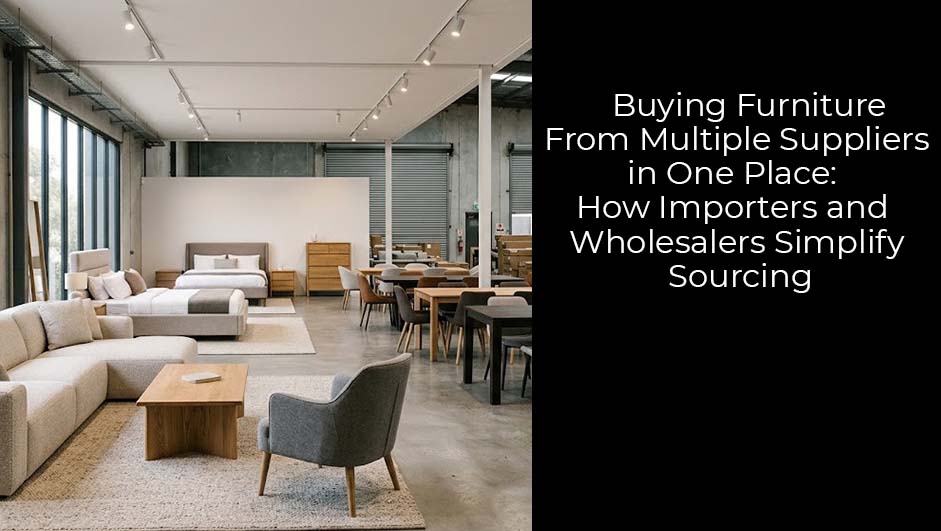
It’s very difficult to create a well-stocked floor of furniture from one factory alone. The wood of your bedroom suites could have been sourced from India or Vietnam, while the upholstery of your lounge sets is from China and your outdoor furniture is from Indonesia or Malaysia. Therefore, the issue is not whether you should buy furniture from multiple suppliers, but whether you would be handling each of these suppliers individually or sourcing the furniture through another supplier, such as Vivin Imports, who does this job for you.
In this buying guide, we will explain where you can source your furniture from several factories at once, whether you can combine categories in one order, the actual cost of doing all this, and how consolidated shipping works.
The Short Answer
The easiest way to buy furniture from several different suppliers in one go is via a furniture importer and wholesaler. The importer buys from a range of factories in various countries, tests the goods, brings them to Australia, and stores them in a warehouse there. You then purchase furniture across different product lines in one go, with one account, one invoice and one contact point for all orders. This is what one-stop furniture sourcing really means.
This is precisely what we do at Vivin Imports. We import contemporary furniture from factories located in India, China, Vietnam, Malaysia, and Indonesia and store it in our distribution centres in Wetherill Park, NSW (25,000 m²); Epping, VIC (15,000 m²); and Wiri, Auckland. We supply exclusively to trade customers such as retailers, interior designers, stylists, and commercial buyers, from major furniture chains to independent stores.
When decorating one’s own house, the ideal place to buy would be from a nearby retailer who carries a wide selection from various manufacturers.
Where Can You Shop for Furniture Sourced From Multiple Suppliers?
Should you be wondering where to buy furniture from various suppliers, then you have a choice of four main avenues. The major distinction among these lies in the amount of responsibility you will take on yourself.
Furniture Importers and Wholesalers
Importers and wholesalers purchase from several factories; they are responsible for the entire importation process, and they will sell from their inventory. You will be able to view the final products, make your purchases according to your needs, and restock your stock when the stock is sold.
Buying Agents and Sourcing Companies
The buying agent located close to the factory will act as a supplier finder and negotiator of prices and inspections, but there will be a cost for that. However, you are still responsible for the order, shipping, clearing the cargo at the port of destination and the risks involved.
Freight Forwarders With Consolidation Warehouses
However, if you currently purchase products from several manufacturers directly, then a freight forwarder will combine these products from a warehouse close to the port into one container. This will resolve the problem with transportation; however, it will not resolve the problem with sourcing. The minimum order size, payment terms and quality control of each factory will still be your responsibility.
Trade Fairs and B2B Marketplaces
Trade shows and business-to-business websites allow you to meet a lot of suppliers at once, which can be helpful in finding new manufacturers. However, each purchase is a separate supplier deal that has unique terms, documentation, and shipping arrangements.
For information on the importer approach in practice, please visit our guide to furniture importers and wholesalers in Australia.
Can You Mix Categories in One Order?
Of course, you can. How this is achieved varies according to whether you are purchasing from the local stock or by the container.
From Local Stock
If you shop from the local warehouse of the importer, a single purchase can contain a bedroom set, two dining settings, some occasional chairs, mattresses and even an outdoor lounge setting, all sourced from different factories in different countries. All is delivered in one single order and invoice. Please keep in mind that if there are different warehouses for the products, deliveries can come in more than one consignment. It remains the easiest way to get the variety of furniture items from different suppliers.
In a Mixed Container
Each factory has its minimum order quantity per product, mostly 50 to 100 pieces of one product in the same finish. A mixed container furniture order solves this by combining several different products in one container, so the total volume fills the space without you committing to 100 units of one item. A shared container goes one step further, where one container is split between several buyers, and each of them pays only for their share of the space.
It should be noted that products to be shipped in one container have to come from the same region. For information on containers' sizes, capacities, and landed cost, please refer to our guide on how to order furniture by container in Australia. Vivin Imports offers both wholesale and direct container sales, so if you are ordering a larger number of products, our team will help you understand what can be ordered in a direct container.
One Supplier or Many? The Real Trade-Offs
This is a comparison of purchasing from multiple suppliers directly versus purchasing from a single importer.
Factor | Buying direct from several suppliers | Buying through one importer |
Price per piece | Lowest factory price, before freight, duty and port charges | Higher unit price, with import costs already included |
Minimum orders | Set by each factory, per product | Order what you need from local stock. |
Cash tied up | Deposits are paid months before stock arrives, often in foreign currency | Pay in Australian dollars, with no factory deposits months in advance. |
Lead time | Around three to four months from order to delivery | Days, for stock held locally |
Quality control | You arrange inspections at every factory. | Checked by the importer before despatch |
Admin | Separate quotes, invoices, payments, documents and customs entries | One account, one invoice, one point of contact |
Design control | Full freedom to customise | Shared ranges, with some exclusive designs |
If something goes wrong | You deal with an overseas factory. | You deal with a local business and its written warranty |
To be truthful, buying directly could give you an advantage in terms of price per unit provided that you have enough volume, space, and people to organise it all. A single importer excels in cash flow, delivery time and saving time. Most retailers do both – direct containers for those best-selling items and local inventory for everything else. Read more in our comparison of wholesale vs direct import.
Is It Affordable to Use One Importer Rather Than Several Suppliers?
A price in the factory will be less expensive compared to a landed price on a per unit basis. However, when the landed cost is considered in full, the difference between the prices becomes small, and sometimes, in small and medium order volumes, the prices become equal.
The factory price does not include sea freight, marine insurance, customs duties, GST on importation, port and clearance expenses, quarantine treatment of the timber, local transport and unloading of the container. There are also hidden expenses that are not included in the invoice: money frozen in deposit, changes in exchange rates between your deposit and your final payment, unsold stock as you had to purchase 100 units, and broken goods that are difficult to return.
Using multiple sources increases the fixed costs. Every single shipment has its clearance fees, documents and transport expenses regardless of the quantity of products being shipped. The importer splits those costs among thousands of pieces, and that is why the price gap is smaller than it seems at first.
How Consolidated Shipping Works
Consolidation in shipping is where products from different factories are shipped in one single container rather than in separate shipments in part loads. Consolidation usually involves the following processes:
Orders are placed with each factory, and production is timed to finish around the same week.
Products are shipped to the consolidation warehouse near the port of loading.
Quantity, packing and timber treatment certificates are examined.
The container is organised by volume, and heavy and fragile items are arranged to ship in safely.
One set of shipping documents and one customs entry cover the whole container in Australia.
The container is unloaded at the local warehouse, and orders are further sent to customers.
However, consolidation can only take place in one region, as products have to go to the same port. Furniture from India, China and Vietnam cannot share one container; thus, an order that involves all these types of furniture can only come together in an Australian warehouse. This is the true advantage of buying from an importer who holds local stock.
Getting Diverse Furniture Options Without a Mismatched Floor
Variety is the reason to have several sources, but variety is also the danger. A "natural oak" finish produced in different factories will never be the same. Chair heights, wood colours and cloth colours can differ from one to another.
A couple of simple rules will save the day:
Purchase collections that go well together instead of separate items from different collections.
Request colour samples and make sure that photos were taken in natural daylight. Colours may also appear differently on different screens; therefore, samples are always better than pictures.
Check dining chair seat heights in comparison with table heights if they were manufactured by different producers.
Have a couple of core collections and surround them with trend collections.
It is much simpler to work with one importer, as the purchase team selects products, keeping in mind the entire floor. In the case of Vivin Imports, this means selecting unique designs like our Eccentric collection, in addition to New Arrivals.
When Buying Direct From Several Factories Still Makes Sense
Direct purchasing may be an option for you if you:
Sell large quantities of just a few products.
Require custom sizes and finishes that fall outside the range of the normal line.
Already have your own warehouse, unloading facilities, and staff who can take care of the quality control and customs work.
Deposit funds now and wait for several months to get stocks.
If this is not the case for you, then local stock would be the more appropriate choice. However, before deciding to purchase directly, do your homework and learn more about the potential difficulties of buying furniture via direct containers.
How Ordering Across Categories Works at Vivin Imports
Our purchasing process has been kept easy, even when you want to buy from multiple categories.
Register for a trade account: You must be an authorised business or an interior stylist.
Select from the complete collection: Select from bedroom, living & dining, lounges & sofas, outdoor furniture, mattresses and our latest collections.
Place orders from different categories at once: Place orders of furniture items from different collections, factories and countries at once. Minimum purchase amounts and payment conditions are determined for every trading account, so consult with our sales department for more information.
Pick from delivery or pick-up: Pick up from our Wetherill Park or Epping distribution centres or select for delivery. Large orders are handled by two people, and there is free delivery for selected items to selected locations. Please contact our office to see if your postcode qualifies.
Enquire about direct containers: When you are ready to place bulk orders, our team will assist you with overseas delivery, customs clearance and quality checking for indent orders.
We also maintain healthy inventory levels before the sales seasons to verify that our retail customers have enough stock during times of high demand.
Tip: We do not provide for change of mind refunds, so please check sizes, finishes, and quantities prior to ordering. Should your item arrive faulty or damaged, we would be happy to assist you in making a return, repair or warranty claim.
Frequently Asked Questions
Can I combine products from different factories in one order?
Absolutely. When purchasing from the local stock of wholesalers, goods produced in various factories and countries come under a single order and a single invoice. If the products are kept in different warehouses, they can be shipped separately. For direct containers, it depends on the importer's programme and on the goods shipping from the same region.
Is it cheaper to use one importer than several suppliers?
Factory pricing will most likely be cheaper on a per piece basis. However, when factors such as freight charges, taxes, port fees, deposits, currency conversion rates and inventory write-offs are considered, one importer emerges cheaper for smaller and medium orders.
How does consolidated shipping work?
The products from various factories are taken to a warehouse located close to the port, checked, and packed into one container. This single container is then shipped using one set of documents and one customs clearance and unpacked into individual customer orders.
What is the difference between a mixed container and a shared container?
A mixed container is one buyer's order made up of various products. A shared container involves dividing one container among several buyers, where each of them pays only for the space they use.
Do I need an import licence to buy from an importer?
No. The importer takes care of the custom and quarantine process. You just require an approved trading account.


